'Hitting drums hard is really cathartic': Can punk improve your mental health?

Alternative rock band ARXX explore mental health in their songs – including those written for BBC drama Riot Women
- Published
New BBC drama Riot Women sees five women find release from personal problems, crumbling marriages and ailing relatives by forming a punk band.
"I remember this guy saying to me that punk isn't suitable for middle-aged women," says Riot Women writer Sally Wainwright.
But the Happy Valley and Gentleman Jack writer thinks the music is "particularly pertinent" for a group she says are made to feel invisible by the world.
For the characters in the BBC series, playing punk music allows them to assert their identities in the world and vent the frustrations of their lives.
Wainwright learned the drums in the process of writing the drama. "When I'm writing," she says, "I sit at my desk for hours. I used to wander off to make a cup of tea, and now I just play the drums. It's very therapeutic to make a hell of a lot of noise."
A new generation of musicians are also finding community, emotional catharsis and a sense of self-confidence in punk music.
'Punk told me it was OK to feel angry'
- Image source, Katie Evans
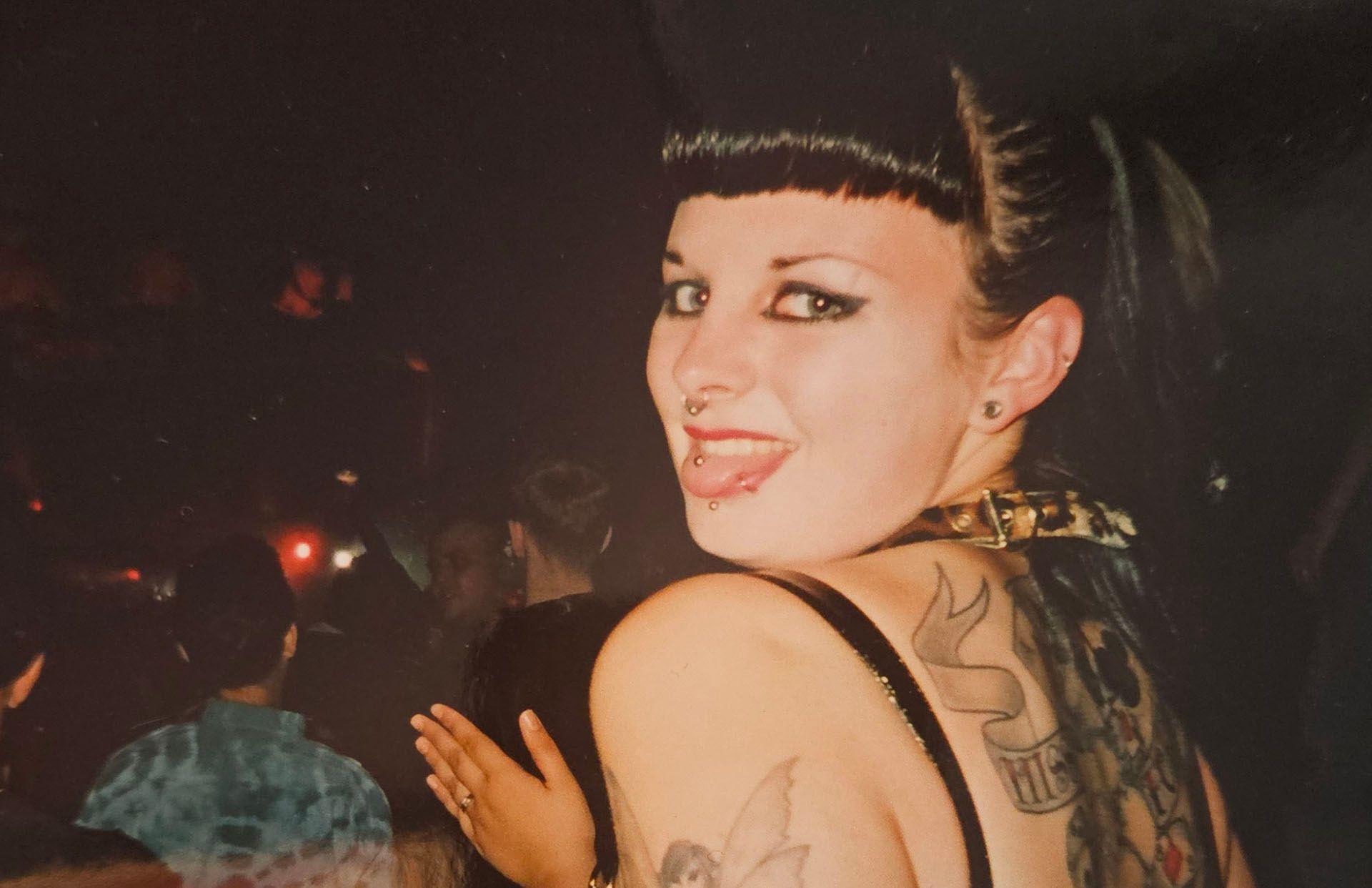
Image caption, In her youth, Katie Evans worked with legendary feminist punk bands like The Slits


1 of 2
Katie Evans was a teenage punk who has since become a psychotherapist, using some of the lessons she learned on the scene to help others struggling with their mental health.
As a teenager, she endured bullying, anxiety and depression, with her anguish at feeling like a "misfit".
In riot grrrl - a 1990s underground feminist punk genre and movement that gave us bands like Hole and Bikini Kill - she found music that resonated with her.
Sally Wainwright also took inspiration from the movement. In Riot Women, it is Violet, a song by Courtney Love's band Hole, that Kitty (played by Rosalie Craig) sings at karaoke when she has hit rock bottom.
"The quality of Courtney Love's voice is extraordinary," Wainwright says. "The lyrics are so spare, so explicit and so emotionally articulate."
"Riot grrrl told me you can be angry as a woman," Evans says. "It helped me realise I was angry, and the music helped me process that."
Her experiences in the punk movement has informed her work as a psychotherapist. "A big part of therapy is around acceptance of the self.
"We need to see our feelings reflected back to us to get a sense of ourselves, to feel like we're not alone."
Trailer: Series 1
Evans sees parallels between exercises psychotherapists use and songwriting. "Creative outlets have been found as a good way to process emotion. We encourage journaling, and writing a song is journaling."
In the BBC series, characters write songs to vent frustrations they have held for decades, including songs like Just Like Your Mother. "A line that a character's husband has thrown at her in an argument," says Wainwright, "that she turns that into a compliment."
A 2015 study, external suggests "extreme" music like punk and heavy metal was effective in regulating the emotions of those who enjoy listening to it.
Evans can even see some mental health benefits in a staple of punk gigs, the ritualistic violence of a mosh pit – an area where in some rock gigs fans vigorously dance and deliberately collide with each other.
She says the unwritten rules of the mosh pits (such as helping people up when they fall) makes it "a controlled place to get some kind of anger out or find joy.
"People connect in the pit. You don't just see people waving their arms around, you see them with their arms around each other."
'Channel emotions into something creative'
- Image source, Ciara McMullan

Image caption, ARXX's Clara Townsend is an advocate for the mental health benefits of drumming


1 of 2
The punk songs at the heart of Riot Women were written by Brighton duo Arxx, whose vocalist Hanni Pidduck (who uses they/them pronouns) found themselves drawn to the guitar as an emotional release.
Struggles with mental health in their youth had left them with emotions they wanted to express, but "weren't really able to articulate" in a time before they had experienced therapy.
Bandmate Clara Townsend also finds emotional catharsis in the drums: "Hitting something really hard for an hour is really cathartic and just gets everything out."
Pidduck, who has written numerous songs about mental health, says their initial lyrics were a form of therapy: "I'm writing because I'm unable to vocalise it in another way."
"If people can channel their emotions into something creative and connect with a community on that level, that's going to help," says Evans
"We get people to work through trauma through joining choirs, and going to a gig is another place where stand together and sing along."
'Joy, community and safety'

In Riot Women, five women find community and self-expression in the process of forming a punk band
Like any community, however, the punk scene has some issues. As a woman in the punk scene, Evans sometimes found she had to "prove herself" to people who questioned her knowledge of music.
Musician Townsend says she has also felt the need to prove herself as someone in the male-dominated field of drumming, with people asking if she was there to set up her boyfriend's drum kit.
For those with problems relating to drugs and alcohol, some elements of the punk scene may be difficult to navigate. "Unfortunately, a lot of it does take place in bars and clubs," says Evans. She adds the key is to find your community within the wider punk community.
In her own life, she found meeting fellow feminist punks hugely important. For those with issues around the misuse of alcohol or drugs, she points to the Straight Edge movement – a scene of punks dedicated to not using alcohol or drugs.
Creating a supportive community is something that Arxx aims to do at every performance. "People who choose to be entertainers have a responsibility to create spaces where people can just feel joy, community and safety," says Pidduck.
All episodes of Riot Women are available to stream on BBC iPlayer and will continue to air every Sunday at 9pm on BBC One.
If you have been affected by any of the issues raised in this story, information and support can be found at the BBC's Action Line website.
