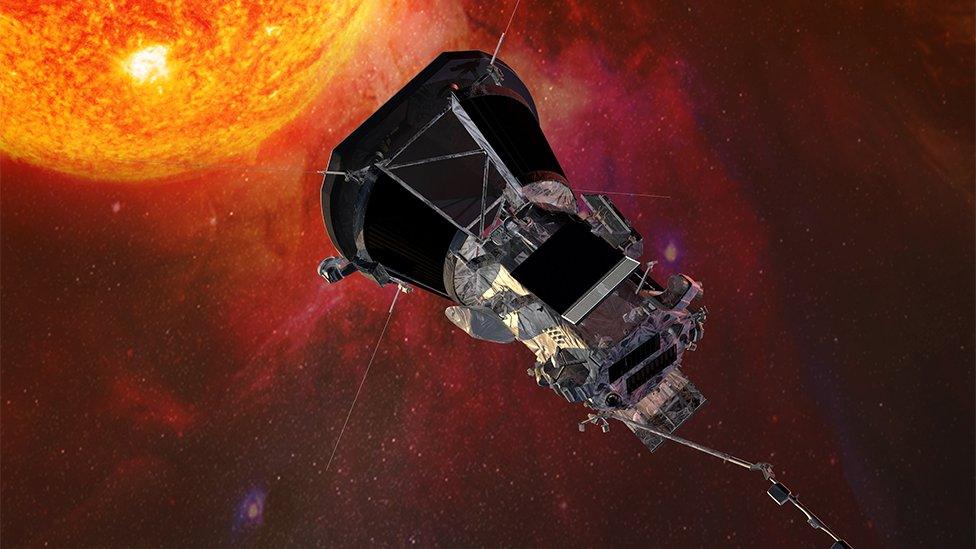
Nasa inventions that affect everyday life
- Published

Nasa technology to be used in space has more of an impact back here on Earth than you might realise.
An annual publication called Spinoff, which has just been published, reveals the amazing Nasa space technologies that are now being used in products and services for ordinary people.
So far, Spinoff has covered almost 2,000 products used back on Earth that began as, or have benefited from, Nasa technology.
Nasa website says: "There's more space in your life than you think!"
Read on to find out more about the Nasa tech that is actually all around you.
Space to surgery
Space agencies all over the world are continually working hard on Mars missions. One big goal of Nasa's is to bring back material from the red planet.
One well-known material developed to do just this is now actually used to stitch up hearts during surgery.
"Any sample canister [containing a sample from Mars to be brought back to Earth] needs a strong seal, both to keep Earth's atmosphere from contaminating the sample and to protect Earth from any potential contamination from Mars," explains Nasa scientist Andy Spry.
But the material developed to help seal these canisters showed some surprising properties.
Relive some of Nasa's biggest moments (Oct 2018)
"It is unique, because it's soft, flexible, and strong - and it's also biocompatible. It's a material that can safely interact in the body and can be safely implanted in the body," explains business manager Wayne Black, who worked on the project.
Because of this, the material called PTFE is used in special stitches for heart surgery. Pretty cool, eh?

The space material being used in surgery on Earth.
Keeping healthy
While astronauts are in space, it's really important that people back on Earth are able to monitor their health - not only to make sure that they are OK, but also to learn more about how bodies respond to being in space.
Spinoff explains: "Technology developed to aid in that monitoring has pushed forward wearable technology here on Earth too, helping create devices that could provide clues to heart disease and more."
A company called Salutron now sells wearable health monitors to people and individual sensors to companies based on research that originally started its life as space research!
So next time you're wearing a piece of tech that monitors your heart rate, you're one step closing than you might think to being dressed as an astronaut.
Tired tyres
Have you ever been in the car with an adult and they've noticed a light on their dashboard switching on to tell them that their tyre pressure isn't right?
Well, the earliest versions of those sensors were originally developed to make sure that the tyres on the space shuttles, which took astronauts to and from the International space Station (ISS), were fully inflated and safe for landing.

Technology used to monitor the tyres on this spacecraft is used in regular vehicles today
In the early years of the space programme, there was no way for astronauts to check the pressure of the tyres mid-air. They used to have to do checks on the ground, which wasn't ideal.
So next time an adult sees their tyre pressure light switch on, you can tell them they might have the shuttle space programme to thank for that.
Impressive plastics
It was Nasa's curiosity that helped this next project. The organisation paid for research to be done into aerogels, which are materials made by creating a gel and removing all the liquid, to create the world's lightest solid.
"[Aerogels] can be cast into tough, flexible, and extremely lightweight sheets and boards of various thicknesses," says the publication.
Nasa wanted to find out how aerogels could be put to good use and discovered that they had potential to be used as an extremely lightweight alternative to plastic.
Stephen Steiner, who founded a company called Aerogel Technologies, now works with aircraft and car makers to look at replacing plastic parts.
He explains: "Our products are able to go into cars and airplanes to make them lighter, which can make them tremendously more fuel-efficient," he says. "That can reduce carbon emissions on a global scale."

Next time you're in a car, have a look around - Nasa research might have had a part to play in the parts you can see
Know your place
Sticking with cars, have you ever seen an adult use a sat nav to work out where they're going?
Well, a key piece of technology needed to do this is called the Global Positioning System - or GPS for short.
And yep, you guessed it, we have Nasa to thank (in part) for that too.
The organisation has decades of experience in using radio signals to extract information, like the size and shape of space objects.
Nasa recognised the potential of the technology and spent a lot of time to develop it further, although many more governments and organisations around the world have invested in it too.
Currently, Nasa is using the technology to develop an instrument to be sent into space in 2020 that will improve weather forecasting based on how the atmosphere refracts the GPS signal.

Here, we see the GPS technology being used to guide self-driving tractors from the farm equipment company John Deere
Water, water everywhere
Or rather, it most definitely isn't in space, so Nasa has had to develop technology to make sure that every drop of moisture on the ISS is reused - even urine!
At a seminar in 2007, a man called Peter Holme Jensen, who was working to develop a water filtration system, met with a Nasa scientist by complete chance. Peter's company was struggling to reach its goal.
With some funding from Nasa, they managed to develop a filtration system based on aquaporins, described as "proteins that all living cells use to transfer water through their membranes".
This tech is now used in water purification systems in normal people's houses and the company is looking at ways to remove the salt from sea water more easily, which could have a massive global impact.
Lucky that those two met, really!

The water filtering system used on the ISS is having a big impact back here on Earth too
- Published20 November 2018
- Published2 January 2019