Coronavirus: What are the latest changes to isolation rules?
- Published

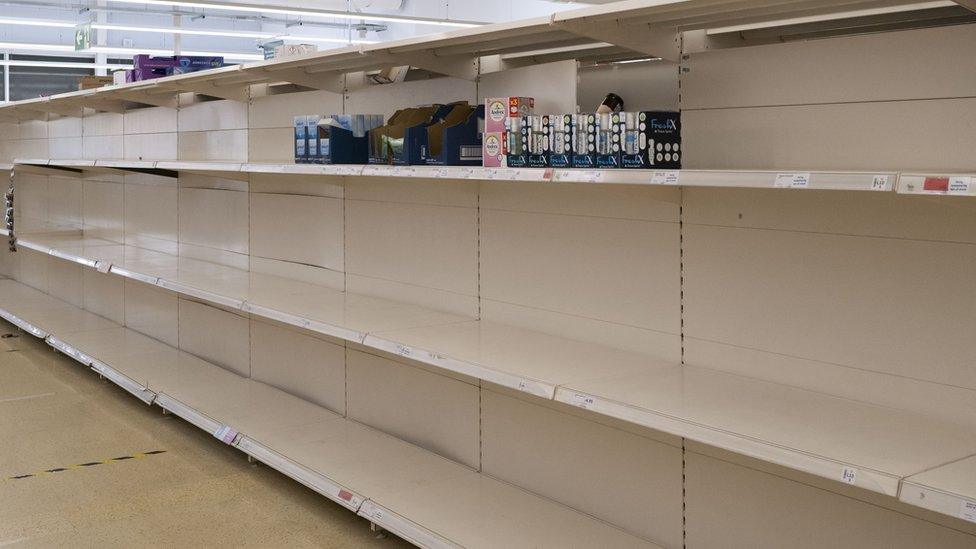
Some supermarkets have been struggling to fill shelves and fridges because staff members are isolating
More than 600,000 people using the NHS Covid app in England and Wales were sent alerts telling them to self-isolate in the week between 8 and 15 July.
This has had a big impact on how the country runs as people have not been able to go to work, including affecting supermarkets.
The government has now said it will be allowing important parts of the food industry to carry out daily testing instead of requiring staff to self-isolate at home. It has changed the rules for some workers to try and reduce the impact of the so called "pingdemic".

People who are "pinged" by the app are advised to self-isolate
The government has said daily testing will now be introduced at key sites, such as supermarket depots, where large quantities of supermarket items are stored, and food manufacturers.
The new daily contact testing measures will begin at 15 supermarket depots, followed by 150 depots next week and it's estimated that close to 10,000 staff at 500 different sites in the UK will eventually be affected.
It will mean depot workers who are alerted by the app or contacted by NHS Test and Trace will be able to continue working if they test negative for Covid, whether or not they are vaccinated.
However, the new testing measures will not apply to supermarket staff working in stores.
Health Secretary Sajid Javid said daily testing of food industry staff would "minimise the disruption caused by rising cases in the coming weeks, while ensuring workers are not put at risk".

The government has said daily testing will be introduced at key sites such as supermarket depots and food manufacturers
Helen Dickinson, who is the chief executive of the British Retail Consortium (BRC), said "disruption is limited at the moment" but it was vital that the government rolls out the scheme as fast as possible and is prepared to take further action if necessary.
Other key industries in England including transport, emergency services, border control and the water industry will also be allowed to start up daily Covid testing instead of self-isolation for a limited number of essential workers.
However, in this case, it will only apply to people who are fully vaccinated and the new rule will only cover workers named on a list kept updated by officials.
What's happening in other parts of the UK?
The government in Scotland is also introducing daily testing for critical staff and services in the country.
Like England, people have been advised to isolate for 10 days after coming into contact with someone who has tested positive.
However, under the Scottish government's new scheme, those working in a range of sectors including health and social care may no longer be required to stay at home and self-isolate.
Supermarket staff and some airline workers might not have to isolate either.
Wales and Northern Ireland are yet to announce any changes to current rules around self-isolation for critical workers.
When will self-isolation rules change?

From mid-August, in England, those who are fully vaccinated and under-18s will be able to take daily Covid tests instead of self-isolating if they come into contact with someone who tests positive for the virus
The government in England has said that from the 16 August, those who are fully vaccinated and children and young people under the age of 18 will be able to take daily Covid tests instead of self-isolating if they are flagged as a close contact of someone who tests positive for the virus.
However, there have been some calls to bring the deadline forward.
What about schools?
Thousands of children across the UK have had to self-isolate over the last school year after coming in contact with a classmate or teacher, or member of staff who has tested positive for Covid.
It has caused a lot of disruption to learning and social activities for lots of pupils, with around one million children staying home from school last week for Covid related reasons.
Official rules around school bubbles came to an end on 19 July and there have been lots of questions about how things will be different once children return to school after the summer break.

Lots of pupils have experienced disruption to their learning over the last school year
The Scottish government is currently reviewing its approach to self-isolation for school children who'll be returning to their classrooms next month and in Wales, the education minister has said he wants to minimise the number of pupils self-isolating.
A new study has found that daily rapid testing of secondary school pupils who are close contacts of someone with coronavirus could be a safe alternative to home isolation.
The researchers, from Oxford University, said daily testing could reduce school absences by up to 39 percent.
Susan Hopkins who is the chief medical adviser for NHS Test and Trace said the study was "a major breakthrough".
"Children and parents have made enormous personal sacrifices throughout this pandemic by isolating when needed, and we all know the disruption it has caused in their lives," she said.
"We've been trying to find safe alternatives, and this study gives us evidence of safe alternatives to isolation for school contacts."
- Published26 July 2021
- Published5 May 2020