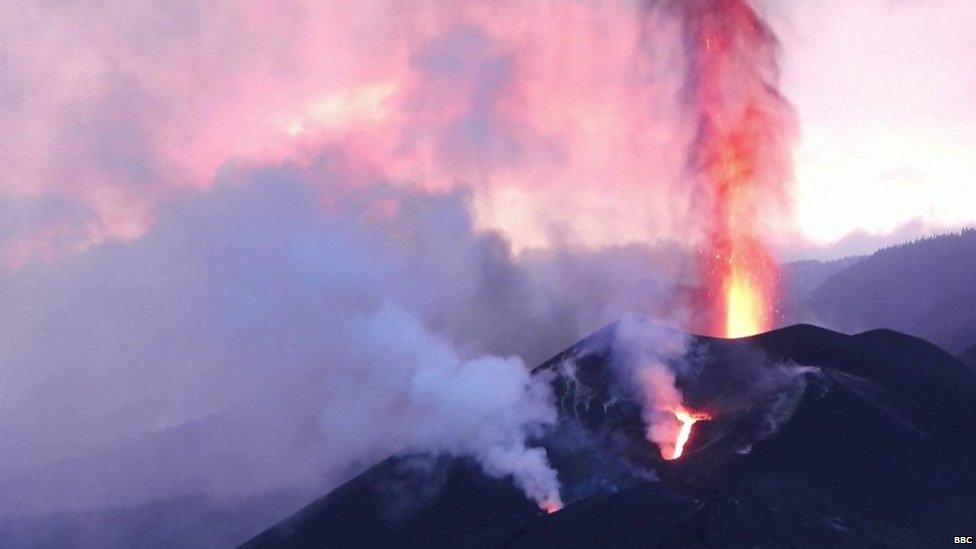
La Palma volcano: Has the record-breaking volcano stopped erupting?
- Published

The Cumbre Vieja volcano smoulders without any activity
The Cumbre Vieja volcano on the Canary Island of La Palma may have stopped erupting after three months of activity.
Since the eruption began on 19 September, hot molten rock, called lava, has destroyed almost 3,000 buildings and forced several thousand people to leave their homes.
It's not the first time activity from the volcano has slowed down, but experts think this time could be different and it is not expected to burst into action again.
"We have a volcano with zero activity, we have no seismicity (earthquakes), we have to be very careful," said a cautious Ruben Lopez, a volcano expert from the National Geographic Institute.
"We can see the volcano had stopped, and maybe we could start to see the end of the La Palma volcanic eruption."

This picture shows a house covered with lava and ash following the eruption of the Cumbre Vieja volcano. Nobody has died as a result of the eruptions

That's not snow, it's ash! This house near the Tacande neighbourhood is covered in ash from the Cumbre Vieja volcano
There has been no earth tremors since Monday evening, which is the longest period without any activity since the eruption began.
Before the volcano went silent, molten rock had leaked into the ocean which increased the size of the island, boiled sea water and released steam in the form of a toxic gas called sulphur dioxide.

This picture shows the Taburiente Public School on the island covered with ash, following the eruption
The gas forced many on the island to stay locked down in their homes, but levels in the air have since been recorded as 'extremely low'.
"We cannot be 100% sure [the volcano has stopped], as the volcano has been playing a few tricks over the last weeks," said geology expert Valentin Troll who has been studying volcanic activity on the island.
The Big Question: Why do volcanoes actually erupt?
The three month long eruption is the longest on La Palma since records began in 1500.
No injuries or deaths have been linked to the eruption on the island, where about 80,000 people live. But many have lost their homes and large areas of land used to grow crops, such as bananas, have been destroyed. Many people on the island rely on the banana plantations to earn money.
The Spanish government has promised 225 million euros (£192 million) to help people living on the island.
- Published7 December 2021
- Published29 November 2021