Nasa Perseverance: Rock sample return moves a step closer
- Published

Nasa’s Perseverance Mars rover after its landing in the area known as Jezero crater on 18 February, 2021 on the planet Mars
Nasa's Perseverance robot landed on the surface of Mars a year ago.
Since surviving its 'seven minutes of terror' it has been surveying the Martian planet and collecting rock samples to be analysed back on Earth for signs of life on the Red Planet.
Getting the collection of rocks back to scientists is easier said than done, but plans are now in place to make it happen. Just don't expect it any time soon!
The earliest these samples will likely return will be in the mid-2030's...
So let's all just be a little patient!
What's the plan?

Nasa's Perseverance rover uses its drill to core a rock sample and will store them in sealed tubes on the planet's surface for this next mission to retrieve them
I'm glad you asked!
Nasa has said that aerospace company Lockheed Martin will be building the Mars Ascent Vehicle (MAV), a lightweight rocket that will launch the rock and sediment that Perseverance has collected.
If this process is successful, not only will the MAV become the first rocket ever to be fired from the surface of another planet, but it will complete all the spaceflight tasks of the Perseverance rover's mission.
If you cannot see the quiz, click here.
But first, the new rocket has to get there. Which is a challenge.
It will have to be strong but lightweight enough to survive the conditions of the red planet, but also small enough to fit inside the Sample Retrieval Lander, part of a spacecraft which will set off from Earth around 2026.
The lander will drop off the MAV on Mars and enable the Perseverance rover to load it with its collection of samples, before blasting back on its return journey.
What will we find out?
Robot wiggle: A video simulation of Perseverance's first drive
Good question! Scientists always planned for the Perseverance Rover to land in a specific area on Mars called the Jezero crater, which the rover has been exploring since it arrived.
This region showed promising signs life may once have existed there.
Salt deposits within the rocks were detected and the theory is if there is salt then groundwater may have once flowed in this region, meaning tiny bubbles of ancient water might still be there.

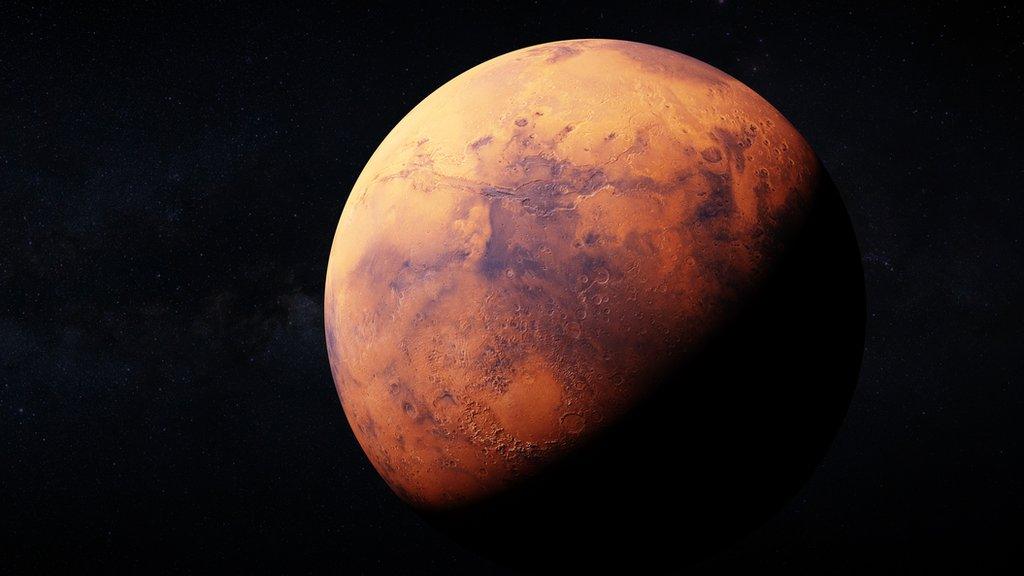
The Jezero crater on the surface of Mars shows the most promising signs alien life may have existed
These bubbles of water could hold evidence of microscopic life. At least, that's what everyone at Nasa is hoping.
But no one really knows for sure. And that's why this mission is so exciting.
The fact is we won't know for at least another 15 years or so... so set a reminder for 2035 (ish).
- Published24 March 2021
- Published8 June 2018
- Published6 May 2020