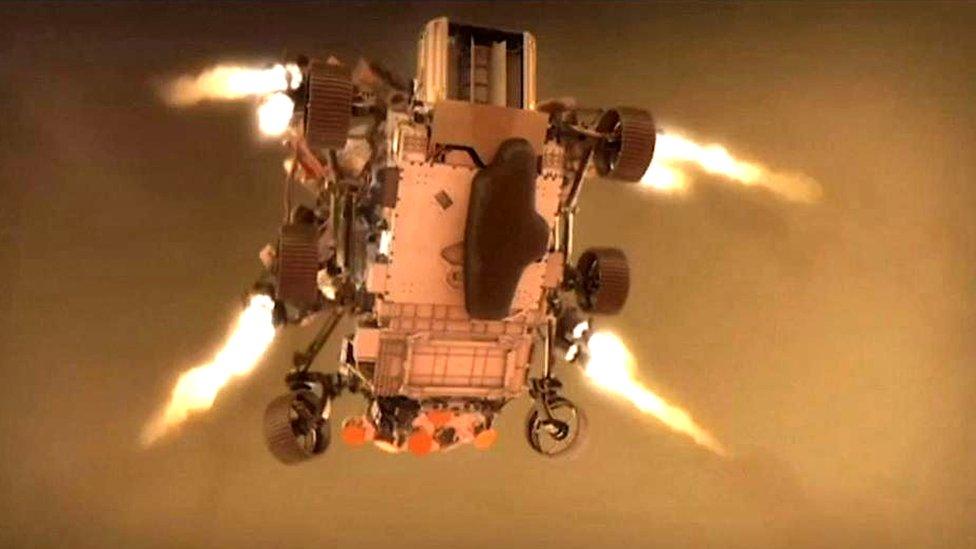
What missions could this space rover be involved in?
- Published
The BBC's Science Editor Rebecca Morelle went to see what jobs it would be best suited to in the future.
This planetary rover is looking for a new job - so what could its special task be?
It's called the Sample Fetch Rover (SFR), or sometimes also Anon, and was originally designed to collect sample tubes left on the surface of Mars by another rover called Perseverance.
But earlier this year Nasa and the European Space Agency (ESA) said this would no longer be necessary, as Perseverance is carrying out his work alone.
It means Anon needs to find a new job!

Staff have been trying to work out what the best way would be of putting SFR to work.
Dr Adam Camilletti, space systems lead at the UK Space Agency, said: "All the technology that's been developed for Sample Fetch Rover is still really, really useful because we've developed a huge amount of expertise and know-how in the UK."
He thinks there are many different jobs the rover could have, including going down tunnels and in difficult terrains, as well as future missions to the Moon and Mars.
One suggestion has been sending it on Moon missions to help with collecting samples from the lunar surface.
But before then engineers have been checking what kind of tasks and landscapes the rover would be able to handle.

It's currently at a quarry in Milton Keynes where Airbus engineers who have been working on the SFR since 2018 are still putting the machine through its paces.
Quarry testing is a very important part of the testing process as it is a similar terrain to what the rover would experience on Mars.
Engineers wants to see how well it can move over different surfaces, to see if it could also be used on the Moon.
This period of testing is the first time all the rover's systems are being tested at the same time.
Even though the mission may have faded away, the core technology is still ready and able to go and this is the kind of the final step in proving that it works.
Ben Dobke, project manager at Airbus, said: "With the Artemis programme happening at the end of the decade, the focus has started shifting towards the Moon.
"So any rovers or autonomous vehicles on the Moon, this software can certainly be applied to that in the future."
Is this rover likely to make it to the Moon?

What a future Moon base could look like
In order for the rover to be used on future Moon missions, engineers will have to reconsider temperatures on the lunar surface, and how to keep key parts of SFR working in the lack of atmosphere.
They will also have to look into how the machine is powered up, after it would have spent 14 nights in sleep mode due to the cold temperatures when it is in darkness.
The SFR prototype has four wheels which makes it very good at finding way around by itself - this makes it able to move much faster than the current six-wheeled ExoMars rover.

Experts have also suggested that even if it weren't to go on a Moon mission, the SFR's technology could be useful for a number of different purposes, for example exploring where there is lunar ice or even helping to build places to live on the Moon!
Mr Dobke said: "It could be in support of human habitats, whether it be autonomously building habitats or whether it's supporting driving astronauts around on the surface.
"So there's a number of different applications that we could have autonomy on the Moon."
- Published6 March 2021
- Published18 February 2021